
Gaïago
🇫🇷Regenerating European agricultural soils
WHAT YOU ARE SUPPORTING
Why this programme exists
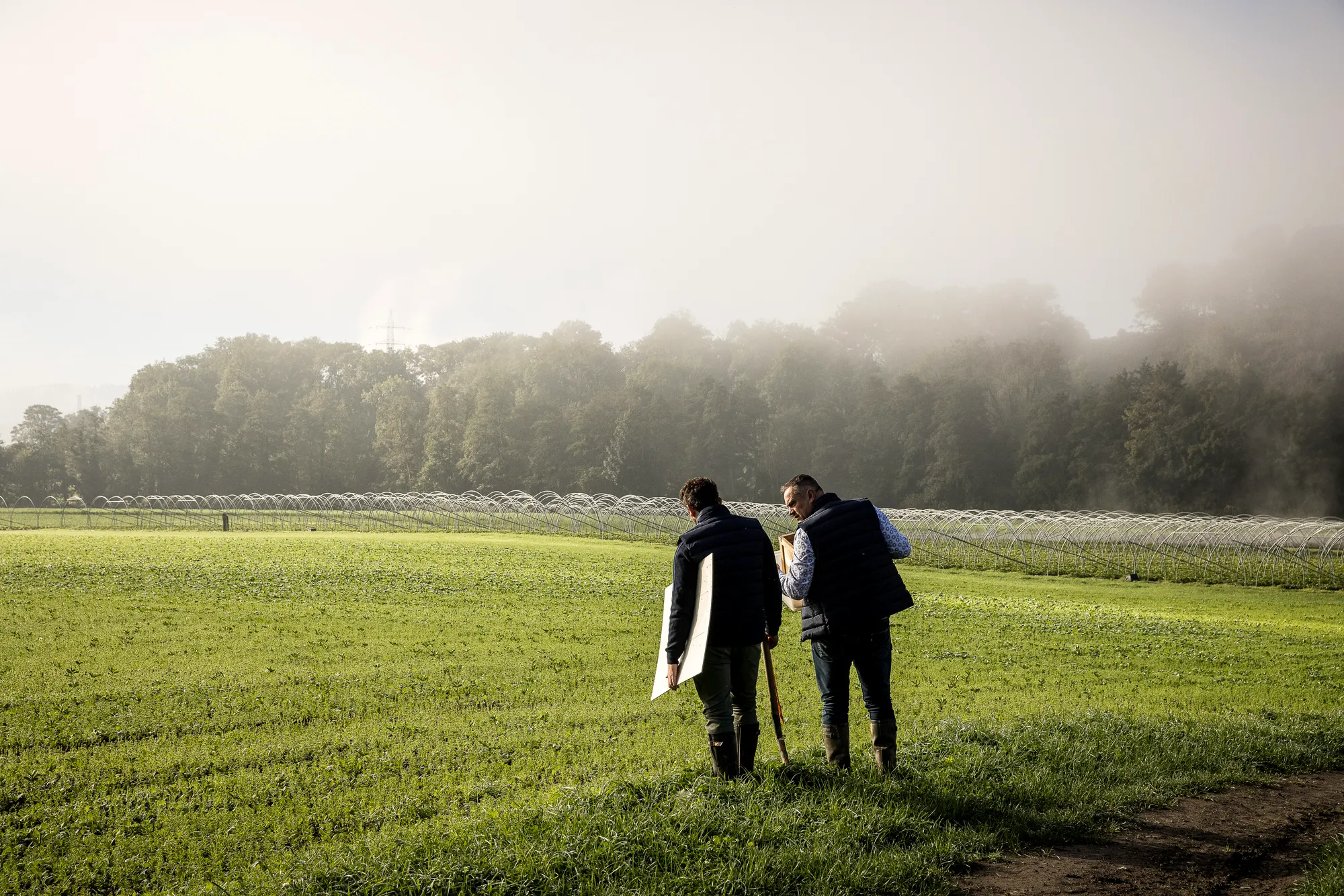
European agriculture is going through a hard stretch. Soils are losing organic matter and holding less water, while the continent has been warming twice as fast as the global average since the 1980s: heatwaves multiply and droughts spread.
Regenerating a soil means restarting its biological life so that it stores more carbon and more water. A farm whose soil holds water resists drought better, depends less on inputs and regains room to manoeuvre. The IPCC counts soil carbon management on croplands among the mitigation levers available today.
60 to 70 %
of soils in the European Union are in an unhealthy state
Commission européenne, Soil health · 2026× 2
Europe has been warming twice as fast as the global average since the 1980s
Copernicus C3S et OMM, European State of the Climate 2024 · 2025- Resilience
- A living soil holds rainwater and gives it back to crops when the summer dries out.
- Autonomy
- Fewer purchased inputs when fertility returns through soil biology.
- Income
- The carbon credit pays the farmer for a practice that lasts.
- Proof
- Each farm is measured at sampling, not modelled, and published on its page.
Why support regenerative agriculture
TERRITORIAL ANCHORING
For a company anchored in a territory, the purchase funds farms it can name, sometimes a few kilometres from its own sites. The commitment can be told locally, to employees, customers and local officials, and it can be checked on a map.
CLIMATE COMMITMENTS
For a buyer carrying SBTi-validated targets, or reselling to those who do, what matters sits elsewhere: traceability, certification standard, vintages, and documentation that holds up in front of an auditor. Both buy the same tonnes and look for different proof.
The programme in brief
Since 2014, Gaïago has developed solutions that stimulate the life of agricultural soils (bacteria, fungi, soil fauna) to restore their natural fertility. Their flagship product, the soil prebiotic Nutrigeo, is sprayed once a year (autumn or spring, depending on the rotation) to reactivate saprophytic and mycorrhizal fungi. It is now deployed on several hundred European farms. The associated carbon programme allows farmers engaged in a regenerative transition to financially value the tonnes of CO₂ sequestered in their soils. The vast majority of cohorts are certified under Gold Standard SOC 402.3, the Gold Standard module dedicated to soil carbon from biostimulants. A minority of legacy cohorts, outside the Gold Standard eligibility window, remain covered by ISO 14064-2, the international verification standard for greenhouse-gas projects. MRV relies on direct measurement of soil carbon following the FAO protocol, complemented by satellite dMRV monitoring (Regrow) and independent verification.
428
Farms
17,280 ha
Total area
367,281
Credits
Gold Standard
Standards
ISO 14064-2 · legacy cohorts
+3.1 tCO₂eq/ha/yr
Average measured sequestration
Nutrigeo programme cohort 1 · ~5,000 ha · 619 parcels
Practices on the programme farms
- 100 %Nutrigeo
- 90 %cover crops
- 50 %organic inputs
- 89 %crop residues left
Value chain of the programme and who does what
A tonne of CO₂ takes this path from a European field to your CSRD report. Seven actors, a 20 percent buffer and twenty-five years of tracking anchor the permanence.
Programme
Farm recruitment, multi-year financing, vintage cohort management, ongoing agronomic support since 2014.
Farm recruitment, multi-year financing, vintage cohort management, ongoing agronomic support since 2014.
Farmers
Yearly application
Nutrigeo prebiotic at the heart of the method, complemented by cover crops and reduced tillage. Deployed on 453 European farms. 5-year commitment with ~100 to 120 EUR/ha/year in additional carbon revenue, measured on the first 5,000-ha cohort.
Nutrigeo prebiotic at the heart of the method, complemented by cover crops and reduced tillage. Deployed on 453 European farms. 5-year commitment with ~100 to 120 EUR/ha/year in additional carbon revenue, measured on the first 5,000-ha cohort.
MRV
FAO 2020 · Regrow dMRV
Direct soil sampling per the FAO 2020 protocol at three key moments: baseline before the programme starts, at the end of year 3, and at the end of year 5, always sampling after full years have elapsed. Complemented by continuous satellite-based dMRV via Regrow.
Direct soil sampling per the FAO 2020 protocol at three key moments: baseline before the programme starts, at the end of year 3, and at the end of year 5, always sampling after full years have elapsed. Complemented by continuous satellite-based dMRV via Regrow.
Verification
DNV (ISO cohorts)
SOC 402.3 cohorts are audited by an independent VVB accredited by Gold Standard; the specific name is listed on the public registry per project. ISO 14064-2 cohorts outside the Gold Standard eligibility window are verified by DNV.
SOC 402.3 cohorts are audited by an independent VVB accredited by Gold Standard; the specific name is listed on the public registry per project. ISO 14064-2 cohorts outside the Gold Standard eligibility window are verified by DNV.
Certification
ISO 14064-2 (legacy cohorts)
SOC 402.3 methodology for every future credit. 20 percent buffer held on registry to cover reversibility risk.
SOC 402.3 methodology for every future credit. 20 percent buffer held on registry to cover reversibility risk.
Sell-side partner
Soil carbon and regenerative agriculture
Direct sales to corporate buyers, or distribution via larger brokers.
Direct sales to corporate buyers, or distribution via larger brokers.
Demand-side partners & corporate buyers
SBTi and BVCM claims
Sold directly to corporate buyers, or placed via demand-side partners (advisors, brokers) who work with large buyers. Credit retirement on public registry, ESRS E1-7 reporting integration, VCMI-aligned BVCM communication.
Sold directly to corporate buyers, or placed via demand-side partners (advisors, brokers) who work with large buyers. Credit retirement on public registry, ESRS E1-7 reporting integration, VCMI-aligned BVCM communication.
Permanence framework
Available volumes by vintage and standard
Gaïago credit supply
Two tables, two distinct perimeters. The first is the Gaïago programme's total production, aggregating every cohort across all commercial partners. The second isolates the contractual subset Arka is authorised to commercialise today.
| Total Gaïago programme volumes | Volumes remaining through Arka | |||||
|---|---|---|---|---|---|---|
| Gold Standard | ISO 14064-2 | Total | Gold Standard | ISO 14064-2 | Total | |
| 2026 | - | 4,314measured | 4,314 | - | 3,867measured | 3,867 |
| 2027 | 248,045246,687 measured1,358 forecast | 7,451forecast | 255,496 | 2,518measured | 4,457forecast | 6,975 |
| 2028 | - | 3,003forecast | 3,003 | - | 2,809forecast | 2,809 |
| 2029 | 99,498forecast | 4,970forecast | 104,468 | 8,722forecast | 2,971forecast | 11,693 |
| Total | 347,543 | 19,738 | 367,281 | 11,240 | 14,104 | 25,344 |
Consolidated across every cohort and every one of Gaïago's commercial partners · Arka is mandated to commercialise a subset of the whole Gaïago programme
Total Gaïago programme volumes
Consolidated across every cohort and every one of Gaïago's commercial partners
| Vintage | Gold Standard | ISO 14064-2 | Total |
|---|---|---|---|
| 2026 | - | 4,314measured | 4,314 |
| 2027 | 248,045246,687 measured1,358 forecast | 7,451forecast | 255,496 |
| 2028 | - | 3,003forecast | 3,003 |
| 2029 | 99,498forecast | 4,970forecast | 104,468 |
| Total | 347,543 | 19,738 | 367,281 |
Volumes remaining through Arka
Arka is mandated to commercialise a subset of the whole Gaïago programme
| Vintage | Gold Standard | ISO 14064-2 | Total |
|---|---|---|---|
| 2026 | - | 3,867measured | 3,867 |
| 2027 | 2,518measured | 4,457forecast | 6,975 |
| 2028 | - | 2,809forecast | 2,809 |
| 2029 | 8,722forecast | 2,971forecast | 11,693 |
| Total | 11,240 | 14,104 | 25,344 |
Non-exclusive allocation, subject to change as Gaïago and its partners execute sales. The volume through Arka is capped at the actual programme volume available for each vintage.
What you are buying
Methodological framing, mapped to the integrity dimensions of the ICVCM Core Carbon Principles.
- Soil-sequestered removal
- Direct soil sampling, 30 cm
- Gold Standard 20% buffer
- Accredited third-party, public registry
The guarantees in detail
Soil-sequestered removal
Credits classified as removal under Gold Standard SOC 402.3. Carbon is sequestered in the soil after prebiotic application, measured on the parcel, with no avoidance or avoidance-equivalent logic.
Direct soil sampling, 30 cm
Physical measurement of soil organic carbon stock at the start and end of the crediting period. Minimum depth 30 cm (IPCC standard for mineral soils). FAO 2020 SOC MRV protocol, Annex 3, authorised under 402.3, complemented by satellite dMRV (Sentinel-2/Landsat via Regrow).
Gold Standard 20% buffer
20% of credits retained in the Gold Standard buffer pool to cover reversal risk. Fixed crediting period under the SOC Framework 402, with a post-issuance practice-maintenance requirement.
Accredited third-party, public registry
Validation and verification by an accredited Gold Standard VVB (SustainCert). Annual monitoring, serial numbers traceable to retirement on the public Gold Standard registry.
GS SOC 402.3 is a module of the Gold Standard Soil Organic Carbon Framework, classified as carbon-removal. ICVCM Core Carbon Principles eligibility for the SOC framework is under assessment.
Methodology and measurement, in detail
Gold Standard SOC Activity Module (402.3) : Soil Organic Carbon from Biostimulants View the spec
Annual monitoring · VVB verification under Gold Standard rules
Soil sampling at the start and end of the crediting period, following Annex 3 of the FAO 2020 SOC MRV protocol authorised under GS SOC 402.3, complemented by Sentinel-2/Landsat satellite monitoring (dMRV via Regrow) and verification by an accredited third-party (VVB) under Gold Standard rules.
Why Gaïago leads
Direct soil carbon measurement
Field sampling per FAO 2020 protocol, verified by accredited Gold Standard third party
+3 tCO₂e/ha/yr removal
Average performance measured across 5,000 ha
A viable transition for the farmer
Carbon revenues of about €100/ha/yr measured on cohort 1, covering the bulk of transition costs. Combined with higher agricultural yields, the bottom line is a net win for the farmer.
Programme-level agronomic results
Aggregated measurements from Nutrigeo programme cohort 1 (~5,000 ha, 619 observed parcels).
+3.1 tCO₂eq/ha/yr
Average carbon result on the equivalent of 5,000 ha (cohort 1)
Carbon sequestered
+30% fine earth fraction
More porous and less compacted soils, observed on 619 parcels
Soil structure
+70% infiltration
+5 to 15 mm extra water stored · Varies between dry and wetter years
Infiltration capacity
+16% fungi
+20% mycorrhized roots · +29% better-decomposed organic matter · Indicators of microbial fertility and organic-matter cycling
Biology & mineralisation
Internal observations from Nutrigeo programme cohort 1 (~5,000 ha, 619 parcels). The tCO₂eq/ha/yr figure is the indicator eligible for certification under GS SOC 402.3; the other measurements are internal programme agronomic indicators. Individual farm performance may vary based on soil type, climate and existing practices.
In the field
projects
Cereal farm (Grand Est, France)
Gaïago
Agricultural operation spanning 858.6 hectares in Betheniville, Grand Est (France), enrolled since 2023 in the Nutrigeo programme to regenerate its soils.
View projectCereal farm (Hauts-de-France, France)
Gaïago
223.5 hectares of cereals (wheat) and flax in Norrent-Fontes, Hauts-de-France (France), in regenerative transition with Gaïago since 2023.
View projectCereal farm (Wallonia, Belgium)
Gaïago
Farm in Vieux Genappe, Wallonia (Belgium) cultivating a mix of cereals, sugar beet, chicory, potatoes and flax across 97.7 hectares, on a soil regeneration pathway since 2023.
View projectCereal farm (Wallonia, Belgium)
Gaïago
Agricultural operation spanning 82.2 hectares in Genappe, Wallonia (Belgium), enrolled since 2023 in the Nutrigeo programme to regenerate its soils.
View projectOilseed farm (Wallonia, Belgium)
Gaïago
Farm in Enghein, Wallonia (Belgium) cultivating a mix of oilseeds, cereals, forage crops, sugar beet and potatoes across 106.3 hectares, on a soil regeneration pathway since 2023.
View projectBeet farm (Flanders, Belgium)
Gaïago
60.3-hectare farm in Zwevegem, Flanders (Belgium), specialising in cereals (wheat, barley) and maize, enrolled in the Gaïago carbon programme since 2023.
View projectCereal farm (Wallonia, Belgium)
Gaïago
Farm in Soignies, Wallonia (Belgium) cultivating cereals, sugar beet, potatoes and flax across 68.8 hectares, on a soil regeneration pathway since 2023.
View projectCereal farm (Wallonia, Belgium)
Gaïago
Agricultural operation spanning 63.9 hectares in Sint-Pieters-Leeuw, Wallonia (Belgium), enrolled since 2023 in the Nutrigeo programme to regenerate its soils.
View projectBeet farm (Wallonia, Belgium)
Gaïago
56.5 hectares of cereals (wheat) and maize in Gooik, Wallonia (Belgium), in regenerative transition with Gaïago since 2022.
View projectCereal farm (Flanders, Belgium)
Gaïago
63.6 hectares of cereals (barley) and maize in Booischot, Flanders (Belgium), in regenerative transition with Gaïago since 2022.
View projectCereal farm (Region not specified, France)
Gaïago
Agricultural operation spanning 214.3 hectares in Henin Beaumont, France (France), enrolled since 2023 in the Nutrigeo programme to regenerate its soils.
View projectVegetable farm (Flanders, Belgium)
Gaïago
Agricultural operation spanning 89.4 hectares in Heuvelland, Flanders (Belgium), enrolled since 2023 in the Nutrigeo programme to regenerate its soils.
View projectBeet farm (Region not specified, Slovakia)
Gaïago
Agricultural operation spanning 236.3 hectares in Blatné, Slovakia, enrolled since 2022 in the Nutrigeo programme to regenerate its soils.
View projectOilseed farm (Burgundy-Franche-Comté, France)
Gaïago
166.8-hectare farm in Andelnans, Burgundy-Franche-Comté (France), specialising in cereals (wheat, barley), rapeseed, legumes and maize, enrolled in the Gaïago carbon programme since 2023.
View projectVegetable farm (Flanders, Belgium)
Gaïago
Farm in Koekelare, Flanders (Belgium) cultivating vegetables, cereals, potatoes, sugar beet and forage crops across 85.7 hectares, on a soil regeneration pathway since 2023.
View projectCereal farm (Hauts-de-France, France)
Gaïago
199.2-hectare farm in Riencourt-Lès-Cagnicourt, Hauts-de-France (France), specialising in cereals (soft wheat), legumes, sugar beet, potatoes and market gardening, enrolled in the Gaïago carbon programme since 2023.
View projectCereal farm (Flanders, Belgium)
Gaïago
Agricultural operation spanning 33.4 hectares in Geraardsbergen, Flanders (Belgium), enrolled since 2023 in the Nutrigeo programme to regenerate its soils.
View projectCereal farm (Flanders, Belgium)
Gaïago
40-hectare farm in Sint-Lievens-Houtem, Flanders (Belgium), specialising in cereals (wheat, barley) and maize, enrolled in the Gaïago carbon programme since 2023.
View projectCereal farm (Hauts-de-France, France)
Gaïago
96.2-hectare farm in Neuville-Saint-Vaast, Hauts-de-France (France), specialising in cereals (other cereals, wheat), rapeseed and legumes, enrolled in the Gaïago carbon programme since 2023.
View projectCereal farm (Hauts-de-France, France)
Gaïago
Agricultural operation spanning 118.8 hectares in Frémicourt, Hauts-de-France (France), enrolled since 2022 in the Nutrigeo programme to regenerate its soils.
View projectCereal farm (Wallonia, Belgium)
Gaïago
61.5 hectares of cereals (soft wheat), flax and sugar beet, maize in Silly, Wallonia (Belgium), in regenerative transition with Gaïago since 2022.
View projectVegetable farm (Flanders, Belgium)
Gaïago
60-hectare farm in Diksmuide, Flanders (Belgium), specialising in cereals (wheat, barley), legumes and maize, enrolled in the Gaïago carbon programme since 2023.
View projectCereal farm (Wallonia, Belgium)
Gaïago
36.9 hectares of cereals (soft wheat), sugar beet, potatoes and market gardening in Fernelmont, Wallonia (Belgium), in regenerative transition with Gaïago since 2022.
View projectVegetable farm (Flanders, Belgium)
Gaïago
Farm in Koekelare, Flanders (Belgium) cultivating vegetables, cereals, potatoes, sugar beet and forage crops across 65.3 hectares, on a soil regeneration pathway since 2023.
View projectReserve credits from this portfolio
Let us know your interest and we'll get back to you to structure your purchase.