Project Kanika
Grow Indigo
🇮🇳Project Kanika · Low carbon rice farming in Telangana, avoiding superpollutant by methane reduction through water management, under Gold Standard, ahead of its first issuance
Registry :Gold Standard · GS23291 (Project Kanika, VPA-01)Gold Standard · GS23290 (PRAN programme of activities)
WHERE
Telangana, southern India
The state of the activity: selected talukas of the Nalgonda, Nizamabad, Suryapet and Yadadri-Bhuvanagiri districts.
WHAT YOU ARE SUPPORTING
Why this project exists
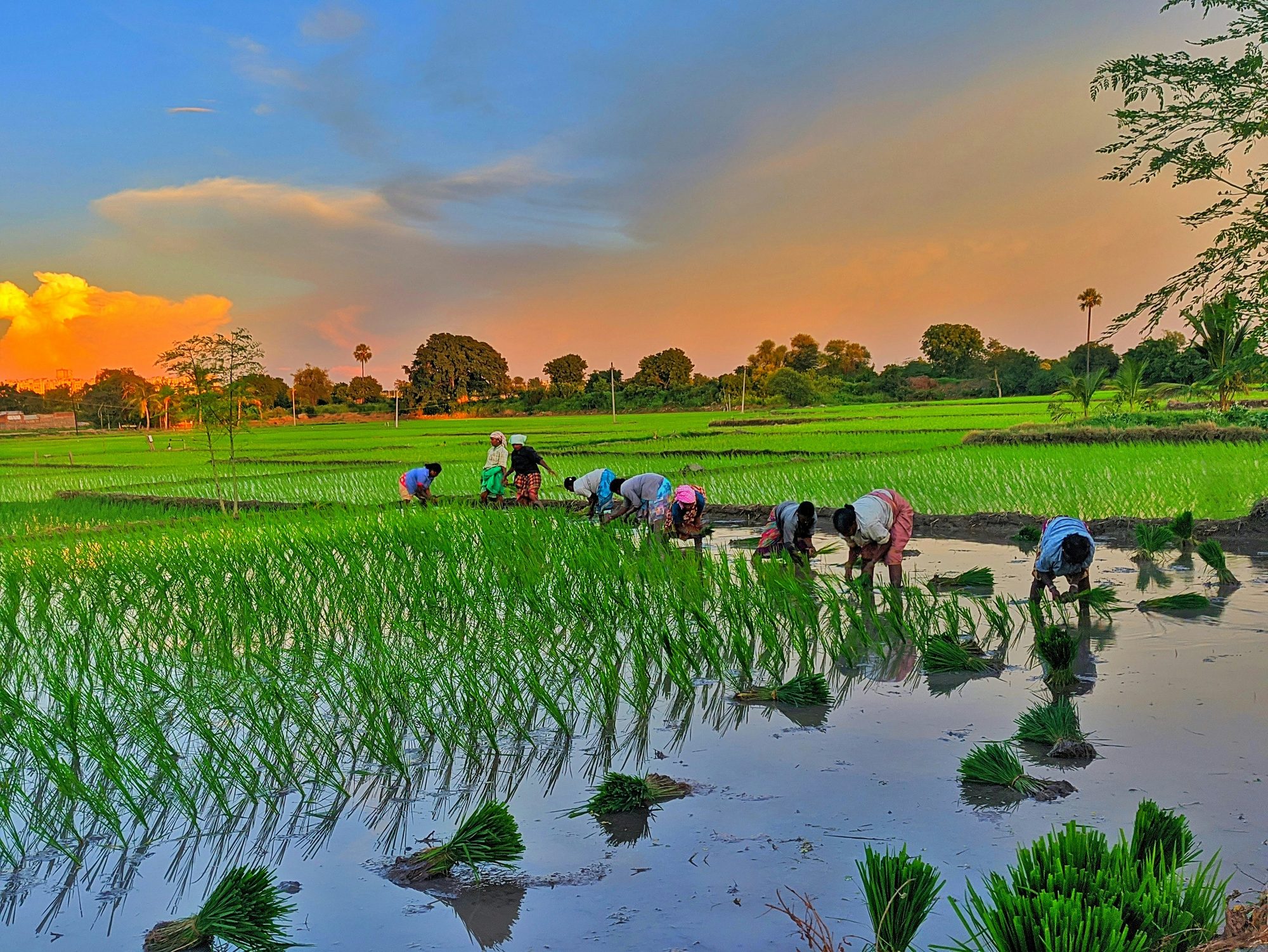
Rice is one of Telangana's main crops: 4.69 million hectares in 2023-24, 12.5% of India's rice production. Paddies are kept continuously flooded, with heavy fertiliser and pesticide use. The standing water produces methane, the nitrogen nitrous oxide.
Alternate wetting and drying, intermittent wetting and drying and direct seeded rice: the activity's rice farmers leave continuous flooding behind. The soil dries out in periods, which cuts the methane. The fields stay the farmers' own, each of them has signed an agreement with the developer.
6,515 ha
of eligible paddies, privately held fields where irrigated rice is grown
VPA design document GS23291 v1.8 · 2026-09-2512.5%
of India's rice production comes from Telangana (2023-24)
VPA design document GS23291 v1.8 · 2026-09-25- Alternate wetting and drying
- The paddy is drained in periods, then flooded again: the soil breathes, the methane drops.
- Intermittent wetting and drying
- Controlled irrigation cycles in place of standing water for the whole season.
- Direct seeded rice
- Rice is sown in the field, without a nursery or transplanting: the pre-transplant flooding window disappears.
- Fields and agreements
- Each field is marked by its bunds and mapped as a GPS polygon. Each farmer has signed an agreement with the developer.
Why a buyer commits
A CCP-approved methodology
Gold Standard's 'Methane Emission Reduction by Adjusted Water Management Practice in Rice Cultivation' methodology, version 1.0, is CCP-approved by the ICVCM. A project's label is confirmed on the registry, at issuance.
Reductions, at the source
The activity counts methane emission reductions, no removals. Small scale: at most 60,000 tonnes a year.
The programme in brief
Grow Indigo Private Ltd, founded in 2018 and based in Mumbai, runs Project Kanika (GS23291), 'GS23290 VPA-01 Low carbon rice farming in India', a voluntary small-scale project activity under Gold Standard's programme of activities 'Promoting regenerative agriculture for nature (PRAN)'. In selected talukas of the Nalgonda, Nizamabad, Suryapet and Yadadri-Bhuvanagiri districts of Telangana, rice farmers move from continuous flooding to alternate wetting and drying (AWD), intermittent wetting and drying (IWD) and direct seeded rice (DSR). The activity covers 6,515 hectares of eligible paddies and counts methane emission reductions, no removals: 32,465 tCO₂e a year on average, within the 60,000 tonnes a year of a small-scale activity. Started on 1 June 2024, it is under validation. The first issuance is expected by June 2027: 38,054 credits of the 2025 vintage.
38,054
Credits expected, first issuance
2025 vintage, issuance expected by June 2027 · Grow Indigo
about 38,000
Annual credit generation capacity
At current scale · Grow Indigo
Gold Standard
Standards
6,515 ha
Eligible paddies of the activity
6,515 hectares, 32,465 tCO₂e a year on average · VPA design document GS23291 v1.8, 25 September 2026
The programme's credits on the registry, by vintage
| Vintage | Credits available | Expected at the next issuance |
|---|---|---|
| 2025 | – | 38,054 |
| Total | – | 38,054 |
Registry totals, across all account holders. Source: Gold Standard Registry, GS23291, 10 October 2026. Expected at the next issuance : First issuance, 2025 vintage, expected by June 2027 · Grow Indigo.
What you are buying
Methodology and measurement, in detail
Gold Standard, Methane Emission Reduction by Adjusted Water Management Practice in Rice Cultivation, version 1.0
Reporting by monitoring period · verification by a Gold Standard-accredited VVB
A voluntary project activity (VPA) under the programme of activities 'Promoting regenerative agriculture for nature (PRAN)', GS23290:
- Each field is mapped as a GPS polygon and marked by its bunds.
- Practices are verified on the farmer's logbook and by on-site assessment.
- Small-scale activity, capped at 60,000 tonnes a year.
Retroactive cycle, started on 1 June 2024. Under validation. No credit issued to date.
What sets Project Kanika apart
A CCP-approved methodology
Gold Standard's methodology for methane emission reduction by adjusted water management in rice cultivation, version 1.0, is CCP-approved by the ICVCM. The activity's label is confirmed on the registry, at issuance.
Reductions, at the source
The activity counts methane reductions, no removals: 32,465 tCO₂e a year on average over 6,515 hectares.
The fields stay the farmers' own
Each farmer has signed an agreement with the developer to implement the practice and enrol the field.
Project snapshots
Reserve credits from this portfolio
Let us know your interest and we'll get back to you to structure your purchase.