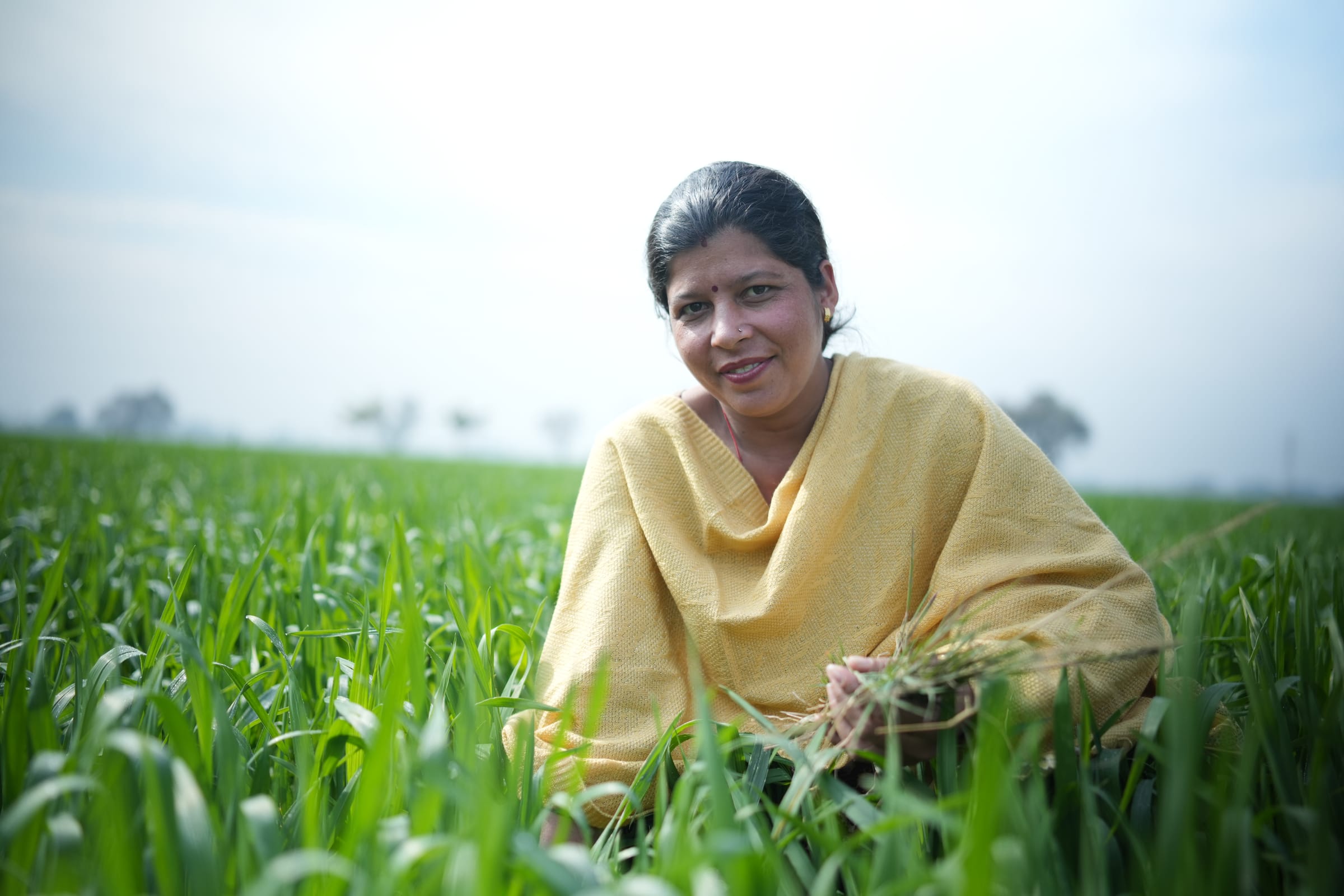
Project Aadi
Grow Indigo
🇮🇳Project Aadi · Regenerative agriculture project rated as 'BBB' by BeZero Carbon with smallholder farmers
Registry :Verra VCS · VCS 2590 (Project Aadi)
WHERE
Punjab and Haryana, north-west India
The two states of the grouped project: ten districts of Punjab and eleven of Haryana.
WHAT YOU ARE SUPPORTING
Why this programme exists
Punjab and Haryana feed India with rice and wheat from farms of a few hectares. Rice is transplanted into flooded fields, the water table drops, and stubble is burnt between two crops: every autumn, the smoke of the fields weighs on the air of the whole north-western plain.
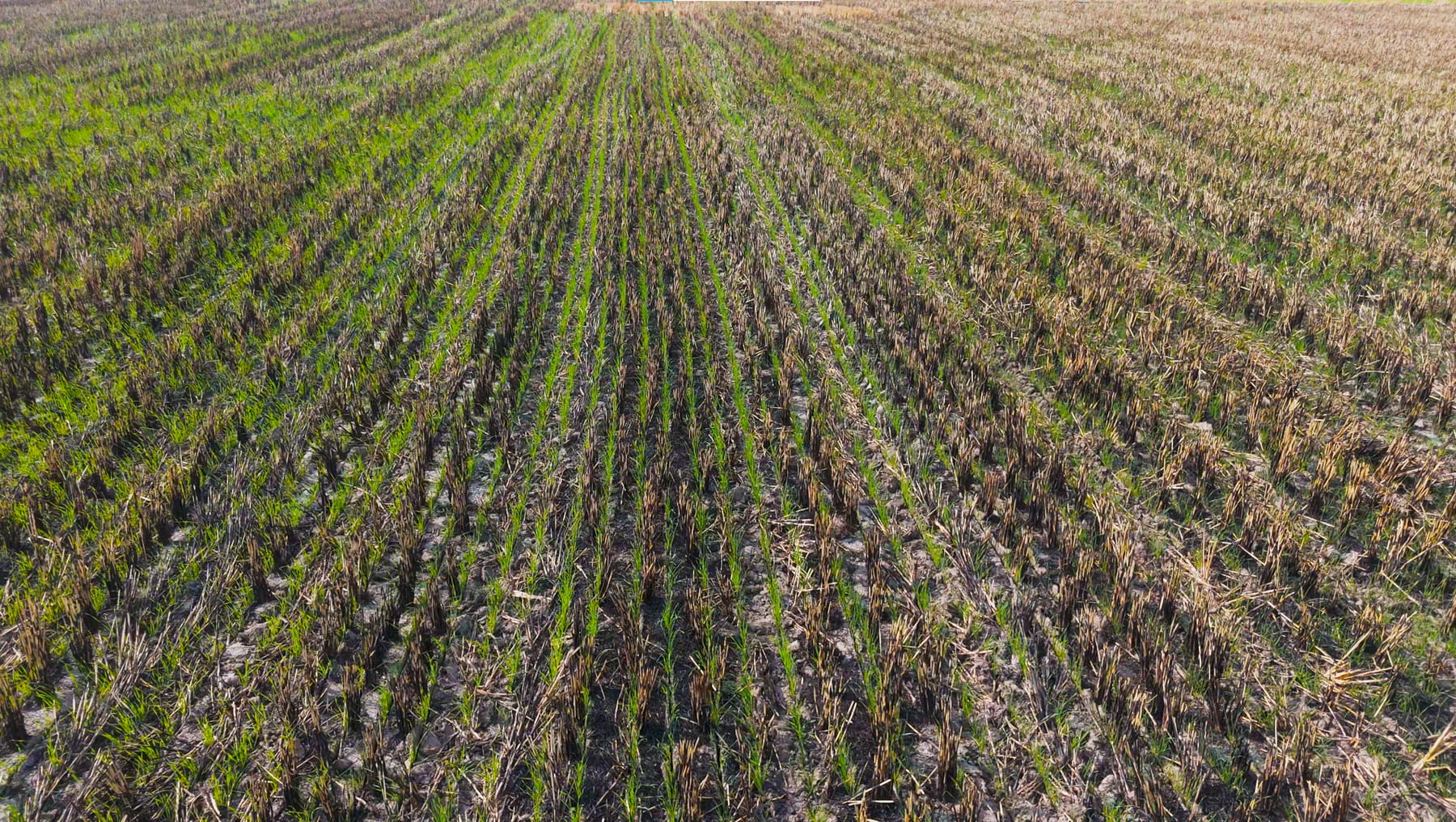
Direct seeding of rice, then reduced tillage in wheat with residue management: these two practice changes store carbon in the soil, cut methane and save water. The carbon credit pays for them, and three quarters of the net proceeds go to the farmer.
156%
of the annual recharge is pumped from Punjab's aquifers, 137% in Haryana, 61% for India as a whole
CGWB, Dynamic Ground Water Resources of India 2025, Lok Sabha reply of 18 December 2025 · 202586%
of Indian farms are under two hectares
Agriculture Census 2015-16, Ministry of Agriculture and Farmers Welfare, India · 201957%
of the first period's credits are removals in the soil
Non-permanence risk report v1.4, Verra, project VCS 2590 · 2026- Water
- Direct seeded rice needs less water: about 1.4 million litres saved per hectare per year, and a water table drawn on less.
- Air
- Wheat is sown under reduced tillage with residue management: stubble burning has ended on enrolled fields.
- Income
- Income is improved by up to 10% due to carbon revenue. Overall livelihood improves by up to 30% in the long run due to cost reduction and higher productivity due to the use of biologicals.
- Proof
- Each field is geotagged, monitored by satellite and sampled. Verification is third-party and the registry is public.
Why support this programme
SMALLHOLDER FARMERS
The purchase funds family farms of a few hectares, and the developer passes three quarters of the net credit proceeds on to them. The commitment can be told with precise practices, identified fields and a public registry.
CLIMATE COMMITMENTS
For a buyer carrying SBTi targets or CSRD reporting: credits issued with Verra, removal share quantified apart, independent rating, serial numbers at retirement.
The programme in brief
Grow Indigo Private Ltd, founded in 2018 and based in Mumbai, runs project Aadi (VCS 2590), registered with Verra under VM0042 version 1 as a grouped project in Punjab and Haryana, started on 6 May 2019 for a twenty-year crediting period. BeZero Carbon rated the project BBB on 18 June 2026. The project is being upgraded to version 2.2 of the methodology. Smallholder farmers move from transplanted rice in flooded fields to direct seeded rice, and from conventional ploughing to reduced tillage in wheat with residue management. The project document also lists water management and reduced fertiliser among the programme's practices. Every field is enrolled through the developer's app, monitored by satellite and soil-sampled. The first monitoring period, 6 May 2019 to 31 May 2022, was verified over 11,636 hectares and 2,550 farmers: 57,463 credits were issued on 10 March 2026, and the risk report counts 57% of them as removals in the soil. The second period, June 2022 to May 2024, covers 101,473 hectares. 251,118 credits are expected at the next issuance. Across the two periods, 83% of the credits are removals and 17% reductions. The project document sets 75% of the net credit proceeds for farmers.
56,063
Credits available
Verra Registry, VCS 2590 · 10 October 2026
2019 to 2022
Vintages issued
251,118
Next issuance expected
Second monitoring period, June 2022 to May 2024 · Grow Indigo, October 2026
400,000+
Annual credit generation capacity
At current scale · Grow Indigo, October 2026
Verra VCS
Standards
83% removals
Removal share over the first two monitoring periods
309,057 t removals of 372,171 t net (57% on the first period alone, 2019 to 2022) · emission reductions and removals sheets of the first two monitoring periods, Grow Indigo. The second period is still to be issued
Value chain of the programme and who does what
A tonne of CO₂ takes this path from a field in Punjab or Haryana to your report. Seven actors, a Verra buffer on removal credits and a crediting period to 5 May 2039.
Programme
Digital enrolment of farms, practice training, field monitoring, funding through credit sales. Grouped project started on 6 May 2019, crediting period to 5 May 2039.
Digital enrolment of farms, practice training, field monitoring, funding through credit sales. Grouped project started on 6 May 2019, crediting period to 5 May 2039.
Farmers
Wheat under reduced tillage
Smallholder farmers in Punjab and Haryana, in the rice, wheat and maize system. Two practice changes credited over the first period: direct seeded rice and reduced tillage in wheat with residue management. The project document also lists water management and reduced fertiliser among the programme's practices. It passes 75% of the net credit proceeds on to farmers, paid in full at the sale.
Smallholder farmers in Punjab and Haryana, in the rice, wheat and maize system. Two practice changes credited over the first period: direct seeded rice and reduced tillage in wheat with residue management. The project document also lists water management and reduced fertiliser among the programme's practices. It passes 75% of the net credit proceeds on to farmers, paid in full at the sale.
MRV
VM0042 version 1
Geotagged field records by 70 agents in the developer's app, multi-date satellite monitoring of fields and practices, stratified soil sampling, quantification by a model calibrated for Indian conditions.
Geotagged field records by 70 agents in the developer's app, multi-date satellite monitoring of fields and practices, stratified soil sampling, quantification by a model calibrated for Indian conditions.
Verification
Independent third party
First monitoring period, 6 May 2019 to 31 May 2022, verified by a Verra-accredited VVB: 62,056 t net, of which 4,592 t to the buffer and 57,463 credits issued on 10 March 2026.
First monitoring period, 6 May 2019 to 31 May 2022, verified by a Verra-accredited VVB: 62,056 t net, of which 4,592 t to the buffer and 57,463 credits issued on 10 March 2026.
Certification
13% buffer on removals · BeZero BBB
Project VCS 2590 under VM0042 version 1, being upgraded to version 2.2. Non-permanence risk rating of 13: 13% of the removal credits placed in Verra's pooled buffer on the first period, 22% afterwards, none on reductions. BeZero rating BBB of 18 June 2026 on the 2019 to 2022 vintages.
Project VCS 2590 under VM0042 version 1, being upgraded to version 2.2. Non-permanence risk rating of 13: 13% of the removal credits placed in Verra's pooled buffer on the first period, 22% afterwards, none on reductions. BeZero rating BBB of 18 June 2026 on the 2019 to 2022 vintages.
Sell-side partner
Non-exclusive mandate
Presentation of the programme to buyers, documentation and structuring of the purchase, from spot to multi-year contract.
Presentation of the programme to buyers, documentation and structuring of the purchase, from spot to multi-year contract.
Corporate buyers and partners
Contribution, SBTi, CSRD
Credits retired on the Verra registry, serial numbers in the report, VCMI-aligned communication.
Credits retired on the Verra registry, serial numbers in the report, VCMI-aligned communication.
The programme's credits on the registry, by vintage
| Vintage | Credits available | Expected at the next issuance |
|---|---|---|
| 2019 | 7,415 | – |
| 2020 | 17,153 | – |
| 2021 | 20,616 | – |
| 2022 | 10,879 | 59,314 |
| 2023 | – | 125,559 |
| 2024 | – | 66,245 |
| Total | 56,063 | 251,118 |
Registry totals, across all account holders. Source: Verra Registry, VCS 2590, 10 October 2026. Expected at the next issuance : Second monitoring period, June 2022 to May 2024, issuance expected between December 2026 and February 2027 · Grow Indigo, 22 October 2026.
What you are buying
Methodological framing, mapped to the integrity dimensions of the ICVCM Core Carbon Principles.
- Removal and reduction, quantified separately
- Calibrated model and sampled soil
- Verra buffer on removal credits
- Verra-accredited VVB, public registry
The guarantees in detail
Removal and reduction, quantified separately
VM0042 quantifies the change in soil carbon stock (removal) apart from the avoided emissions (methane from flooded rice, nitrous oxide, CO₂), both through the same model. Over the first two monitoring periods, 83% of the credits are removals and 17% reductions. On the first period alone, removals are 57%.
Calibrated model and sampled soil
Quantification by a biogeochemical model, calibrated and validated under Verra's VMD0053 guidance and adjusted to Indian conditions, on fields geotagged in the programme's app, monitored by satellite and sampled in strata. An uncertainty deduction of 4,269 t on the first period.
Verra buffer on removal credits
Non-permanence risk rating of 13: 13% of the removal credits placed in Verra's pooled buffer on the first period (4,592 t), 22% on the following periods. Reduction credits carry none. The agreement signed with each farmer binds them over the project's lifetime, to 5 May 2049, for a crediting period to 5 May 2039.
Verra-accredited VVB, public registry
Verification by a Verra-accredited third party (VVB). Serial numbers public on the registry, traceable to retirement.
The project is registered under VM0042 version 1 and is being upgraded to version 2.2, the version the ICVCM retained for the CCP label, approved on 30 October 2025.
Methodology and measurement, in detail
Verra VM0042 v1, Improved Agricultural Land Management View the spec
Reporting by monitoring period · verification by a Verra-accredited VVB
Four layers, under VM0042 version 1, now being upgraded to version 2.2:
- Geotagged field records through the developer's app, by 70 field agents.
- Multi-date satellite monitoring of fields, crops and practices.
- Soil sampling stratified by soil type, crop and practice.
- Quantification by a model calibrated for Indian conditions.
The first monitoring period (6 May 2019 to 31 May 2022) was verified by a Verra-accredited VVB. Verra issued the credits on 10 March 2026.
What sets Grow Indigo apart
Issued and verified under VM0042 at smallholder scale
57,463 credits issued by Verra on 10 March 2026 for the 2019 to 2022 vintages, verified by a Verra-accredited VVB, on farms of a few hectares.
Rated BBB by BeZero Carbon
Rating of 18 June 2026 on the 2019 to 2022 vintages: one of the highest rated VM0042 projects to date.
75% of net credit proceeds to farmers
Paid in full once the credits are sold, under the farmer agreement. Income is improved by up to 10% due to carbon revenue, and overall livelihood improves by up to 30% in the long run due to cost reduction and higher productivity due to the use of biologicals.
Results of the first monitoring period
6 May 2019 to 31 May 2022. Joint project description and monitoring report v7.0 filed with Verra, verified by a Verra-accredited VVB.
11,636 ha
After 6,452 ha the first year and 8,845 the second, on 3,324 fields moved to the programme's practices
Eligible area in the third year
2,550
4.6 ha per farmer on average
Farmers enrolled
57,463 VCU
After a buffer of 13% of the removal credits (4,592 t), issued on 10 March 2026
Credits issued
2.1 / ha / yr
57,463 VCU over 26,933 hectare-years, the three yearly areas added together
Credits per hectare per year
Yearly eligible areas from the first period's emission reductions and removals sheet filed with Verra. Credits from the issuance record of 10 March 2026.
Project snapshots
Reserve credits from this portfolio
Let us know your interest and we'll get back to you to structure your purchase.